Thesaurus Bookshop
WHAT IS SO GREAT ABOUT A KINDLE? NOTHING!
I just don't get it. A Kindle is an ebook reading device from Amazon. Thats all it is. It is not the most beautiful thing in the world that some people seem to think it is.
There are many other reading devices out there that are a good as or if not better than a Kindle.
People bang on about how good Kindle's are without really exploring other options.
With most other ebook reading devices you can get books from any eBook source as well as Amazon.
Even an ipad is better that a Kindle. With an ipad you can buy books from iBooks but you can also purchase eBooks from any other eBook website.
With a Kindle you have to purchase all your eBooks from Amazon. In general they are not the cheapest source of eBooks on the market.
You are cutting out all the other suppliers of eBooks including our eBook site Thesaurus's eBook Store .
Locally produced eBook sites have a huge range of Australian content. Amazon has very little Australian content. They just don't care.Also most Australian eBook sites are very price competitive. You are also supporting your local shop. I say this not because I think you should out of some kind hearted desire to support us but because it does not make sense not to when our prices are competitive.You may be paying the GST but that is also money that stays in the Australian economy.
I was talking to a guy today who was going on an overnight bike ride and was going to take his kindle because it was so convenient. Hello! How many books was he going to read overnight? He will probably read a few pages of one book. I put it to him that perhaps one paperback may be just as convenient probably more so. It is lighter, it bends and will not break, it works when its wet or dirty. As I said I just don't get it.
So lets put things into perspective and don't get caught up in all the eBook spin that we are being fed.
Myth 1: Kindle books are generally no cheaper than most Australian eBook web sites including our own.
Myth 2: On an eBook you can take hundreds of books away with you on holiday. True, but how many books does the average person read on holiday. One maybe two. Why not take a couple of paper books. They are light, you can bend them, they will not break or scratch, it doesn't matter if you lose it or leave it behind.
Myth 3: Kindle books are easy to download. Well, so is every other ebook.
If you want to try an eBook use your iPad or Android tablet. With those devices you can do lots of other social networking things. Don't buy a Kindle!

At Thesaurus We Love People Who Love Books!
Showing posts with label Independents. Show all posts
Showing posts with label Independents. Show all posts
Wednesday, September 19, 2012

Wednesday, October 19, 2011
Reading Between the Shelves
This article was orginally published on upstart on the 31st March 2011
Reading between the shelves: A voice from the independent book industry
Tensions have been brewing in the Australian book industry over recent years, as the impacts of a shifting marketplace begin to be felt. This friction has spilled out into the media since the owner of both Borders and Angus & Robertson, REDgroup, went into voluntary administration in February.
However in the resulting commentary there has been very little space for Australia’s independent booksellers. These voices are necessary for an accurate and informed discussion to take place.
In the current debate there has been substantial consumer complaint about prices and misinformed discussion about the rise of online shopping and e-readers. This has been reinforced by REDgroup’s attempt to deflect attention from poor business practice by inflaming consumer sentiment against the Australian book trade instead.
Debate is a good thing, but in order for an accurate and informed discussion to be taking place there needs to be two sides. Consumers might have a right to source books from wherever they desire but this right should be informed. The current one-way commentary is misleading for online experiences and e-readers are not as fabulous or choice-enhancing as we are being led to believe.
In the media there has been a consistent campaign to discredit the trade and in the face of this so-called popular discourse there has been little or no public support for independent booksellers. Australia has a unique industry where, unlike anywhere else in the world, over 20 per cent of the bookshops are independent retailers. The Australian Booksellers Association has not yet risen to the challenge of representing these members of the book trade.
REDgroup argues that its failure is all to do with e-readers and people sourcing cheaper books online, but this is clearly spin that distracts from their stores not catering to customer needs. Stock in these stores had become so diversified that it has diversified into nothing. Do we as customers really want a bookstore that sells kitchen appliances? Do we really want the recommended retail prices raised on most stock to subsidise unrealistic specials? In times when the retail market gets tough it is most often the poorly run businesses that fall. A large part of surviving in the book industry is about reading and sharing your reading with others. It is not about grabbing market-share and launching failed attempts at monopolies.
Buying online is not necessarily cheaper; it fluctuates. It is not always possible to preview a book before paying for it, and good luck if you need to return it for any reason. It is a complete fallacy that people always have an improved shopping experience online.
Borders also has an extensive online presence and its own e-book business. Maintaining that increased online sales have busted its business is untenable. It may be a contributing factor to a changing industry but it is not the root cause of its voluntary administration.
In regards to industry publishing protections, REDgroup supported the 30 day overseas embargo even under its proposal to ease import restrictions. The Rudd Government was right to reject the Productivity Commission recommendations to allow parallel imports of books. It would not have reduced prices for consumers and it would not have prevented the business failings of Angus & Robertson and Borders.
E-readers are the other ‘life-changing’ and exciting technology that is challenging our book industry — or becoming an integral part of the industry, depending on whose spin you are buying into. Clearly they do have a role, but the extent and popularity of e-readers is generally overplayed. In many situations they are completely impractical and the quality of the print, backlighting and ‘ink’ has yet to match the quality of the printed text.
There is no replacement for the tactile feel of turning a page, of breathing in the simultaneously fresh and musty smell of a new book; as you flick through, inhale and savour those pages that hold the story. Remember that iconic image ingrained into our collective consciousness of a lady on a beach, with a big floppy sunhat, lying back on a towel with a paperback bent open. Everyone dreams of the time to indulge in such practice. This might sound a trifle nostalgic, but it is also practical. Sand does not agree with technology; neither does water, nor young children. The e-book you bought might have been cheaper but the e-reader you have to replace is a whole lot more expensive.
Where is the Australian Booksellers Association’s voice here? It is time that our industry body advocated for the book industry in all its forms. The amount of discussion with customers in our shop about Angus & Robertson and Borders going into administration has been enormous. Contrary to the persistent mutterings in the media about prices, internet and e-readers the majority of consumers are genuinely concerned about the book industry. You do not have the opportunity for face-to-face gossip on the internet. Nor will you receive cheerful advice on what to buy for an eight-year-old or your mother-in-law before having your chosen gift wrapped in pretty paper.
We need to move beyond the spin of REDgroup and its so-called justifications for its collapse in order to preserve the integrity of the remaining businesses in the book trade. A bit of love and a positive attitude for books would go a long way in reminding people of how lucky we are in Australia to have many alternatives to Angus & Robertson and Borders. Let us creatively respond to the shifting dynamics in the book trade rather than blaming the internet, technology and the government.
Whatever happens we will not stop reading; instead people will read in a number of different ways all at the same time. People love books and there is something inherently human about escaping into the pages of another world. Some consumers may choose to access this from a screen; others might ship it in from overseas. But a substantial number of people still really love the opportunity to pop back into the store where they purchased the book and share how much they loved it. Booksellers love that interaction too. It informs our hand-selling, our buying, our knowledge of books and, ultimately, our service.
Currently our industry representatives are underestimating the wonder and uniqueness of what lies within our Australian book trade. Fortunately, like books, you cannot judge an industry by its cover.
Tilly Lunken has just completed her Bachelor of Arts (Honours) in Creative Writing and is an employee at Thesaurus Booksellers and ABC Centre. She is currently trying to finish Germaine Greer’s The Female Eunuch. This piece originally appeared on her blog, Onomatopoeia.
Reading between the shelves: A voice from the independent book industry
Tensions have been brewing in the Australian book industry over recent years, as the impacts of a shifting marketplace begin to be felt. This friction has spilled out into the media since the owner of both Borders and Angus & Robertson, REDgroup, went into voluntary administration in February.
However in the resulting commentary there has been very little space for Australia’s independent booksellers. These voices are necessary for an accurate and informed discussion to take place.
In the current debate there has been substantial consumer complaint about prices and misinformed discussion about the rise of online shopping and e-readers. This has been reinforced by REDgroup’s attempt to deflect attention from poor business practice by inflaming consumer sentiment against the Australian book trade instead.
Debate is a good thing, but in order for an accurate and informed discussion to be taking place there needs to be two sides. Consumers might have a right to source books from wherever they desire but this right should be informed. The current one-way commentary is misleading for online experiences and e-readers are not as fabulous or choice-enhancing as we are being led to believe.
In the media there has been a consistent campaign to discredit the trade and in the face of this so-called popular discourse there has been little or no public support for independent booksellers. Australia has a unique industry where, unlike anywhere else in the world, over 20 per cent of the bookshops are independent retailers. The Australian Booksellers Association has not yet risen to the challenge of representing these members of the book trade.
REDgroup argues that its failure is all to do with e-readers and people sourcing cheaper books online, but this is clearly spin that distracts from their stores not catering to customer needs. Stock in these stores had become so diversified that it has diversified into nothing. Do we as customers really want a bookstore that sells kitchen appliances? Do we really want the recommended retail prices raised on most stock to subsidise unrealistic specials? In times when the retail market gets tough it is most often the poorly run businesses that fall. A large part of surviving in the book industry is about reading and sharing your reading with others. It is not about grabbing market-share and launching failed attempts at monopolies.
Buying online is not necessarily cheaper; it fluctuates. It is not always possible to preview a book before paying for it, and good luck if you need to return it for any reason. It is a complete fallacy that people always have an improved shopping experience online.
Borders also has an extensive online presence and its own e-book business. Maintaining that increased online sales have busted its business is untenable. It may be a contributing factor to a changing industry but it is not the root cause of its voluntary administration.
In regards to industry publishing protections, REDgroup supported the 30 day overseas embargo even under its proposal to ease import restrictions. The Rudd Government was right to reject the Productivity Commission recommendations to allow parallel imports of books. It would not have reduced prices for consumers and it would not have prevented the business failings of Angus & Robertson and Borders.
E-readers are the other ‘life-changing’ and exciting technology that is challenging our book industry — or becoming an integral part of the industry, depending on whose spin you are buying into. Clearly they do have a role, but the extent and popularity of e-readers is generally overplayed. In many situations they are completely impractical and the quality of the print, backlighting and ‘ink’ has yet to match the quality of the printed text.
There is no replacement for the tactile feel of turning a page, of breathing in the simultaneously fresh and musty smell of a new book; as you flick through, inhale and savour those pages that hold the story. Remember that iconic image ingrained into our collective consciousness of a lady on a beach, with a big floppy sunhat, lying back on a towel with a paperback bent open. Everyone dreams of the time to indulge in such practice. This might sound a trifle nostalgic, but it is also practical. Sand does not agree with technology; neither does water, nor young children. The e-book you bought might have been cheaper but the e-reader you have to replace is a whole lot more expensive.
Where is the Australian Booksellers Association’s voice here? It is time that our industry body advocated for the book industry in all its forms. The amount of discussion with customers in our shop about Angus & Robertson and Borders going into administration has been enormous. Contrary to the persistent mutterings in the media about prices, internet and e-readers the majority of consumers are genuinely concerned about the book industry. You do not have the opportunity for face-to-face gossip on the internet. Nor will you receive cheerful advice on what to buy for an eight-year-old or your mother-in-law before having your chosen gift wrapped in pretty paper.
We need to move beyond the spin of REDgroup and its so-called justifications for its collapse in order to preserve the integrity of the remaining businesses in the book trade. A bit of love and a positive attitude for books would go a long way in reminding people of how lucky we are in Australia to have many alternatives to Angus & Robertson and Borders. Let us creatively respond to the shifting dynamics in the book trade rather than blaming the internet, technology and the government.
Whatever happens we will not stop reading; instead people will read in a number of different ways all at the same time. People love books and there is something inherently human about escaping into the pages of another world. Some consumers may choose to access this from a screen; others might ship it in from overseas. But a substantial number of people still really love the opportunity to pop back into the store where they purchased the book and share how much they loved it. Booksellers love that interaction too. It informs our hand-selling, our buying, our knowledge of books and, ultimately, our service.
Currently our industry representatives are underestimating the wonder and uniqueness of what lies within our Australian book trade. Fortunately, like books, you cannot judge an industry by its cover.
Tilly Lunken has just completed her Bachelor of Arts (Honours) in Creative Writing and is an employee at Thesaurus Booksellers and ABC Centre. She is currently trying to finish Germaine Greer’s The Female Eunuch. This piece originally appeared on her blog, Onomatopoeia.
Saturday, October 8, 2011
The Guardian Idependent Bookshops a UK Guide.
In our International Book-y Blogroll on the left of this page there are links to The Guardian Books Page that will lead you to lots of different articles and interviews and also to an Independent Bookshops a UK Guide.
This is a fantastic initiative! What a lovely idea - a national platform that is an interactive platform for the Independent Book Industry in the UK. Unlike Australia the market-share in the UK is not as strong for the Independents but they are still integral for the book community and ultimately for the industry (which on occasion might pretend it doesn't need the little ones but as was proved with Borders it actually is the little ones that stick through and through).
What is also important about this site and the links to the directory is that it is run or at least set up by a national newspaper. Perhaps it is time for a similar resource to be implemented in all markets across the world? It is certainly a excellent resource for customers as well as industry. It is such a warm-fuzzy sort of idea to create an online community where customers/ authors too can contribute. A fine example of how creative and innovative ideas can work together with technology.
Perhaps (tongue firmly in cheek) a certian small-business-minister might even get on board!
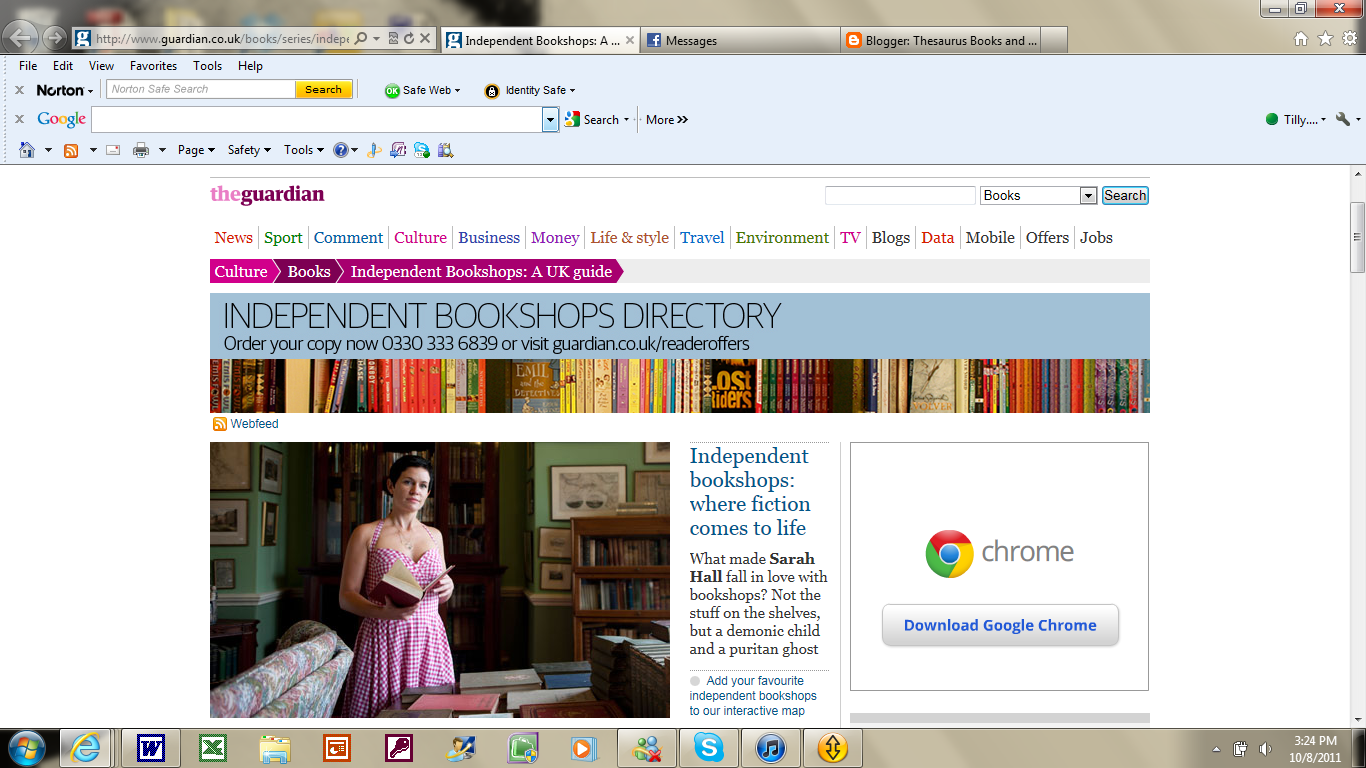 |
| Independent Bookshops UK Guide on The Guardian website |
This is a fantastic initiative! What a lovely idea - a national platform that is an interactive platform for the Independent Book Industry in the UK. Unlike Australia the market-share in the UK is not as strong for the Independents but they are still integral for the book community and ultimately for the industry (which on occasion might pretend it doesn't need the little ones but as was proved with Borders it actually is the little ones that stick through and through).
What is also important about this site and the links to the directory is that it is run or at least set up by a national newspaper. Perhaps it is time for a similar resource to be implemented in all markets across the world? It is certainly a excellent resource for customers as well as industry. It is such a warm-fuzzy sort of idea to create an online community where customers/ authors too can contribute. A fine example of how creative and innovative ideas can work together with technology.
Perhaps (tongue firmly in cheek) a certian small-business-minister might even get on board!
Subscribe to:
Posts (Atom)